Highest Paying Government Jobs in India: Government jobs are highly respected and coveted in India. They come with several perks such as a good salary, work-life balance, retirement benefits, and much more. Every year, lakhs of citizens apply for a handful of positions in several government sectors.
In this page, we talk about the top 10 highest-paying government jobs in India, their salaries, and the benefits they offer.
Highest Paying Government Jobs in India with Salary
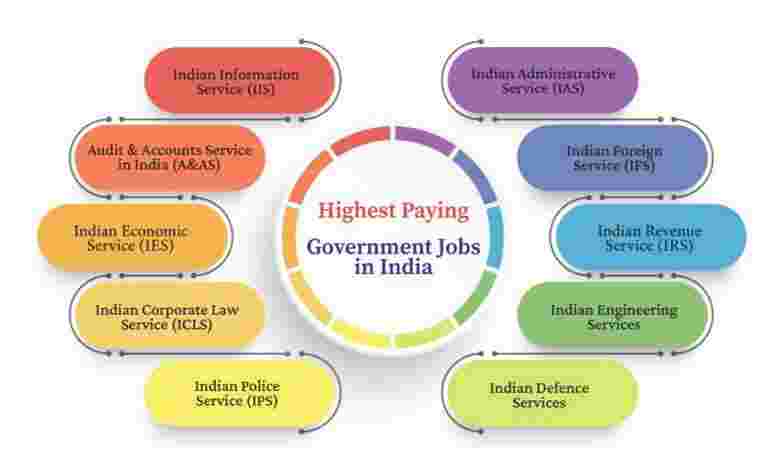
The eligibility criteria for the highest paying govt jobs in India are quite simple. But securing a job can be difficult given the lakhs of applicants and the limited number of open positions.
Let’s take a look at the 10 highest paying government jobs in India and the eligibility criteria for them!
Note: These salaries are based on a number of factors such as location, age, etc., and are subject to change.
| Government Jobs | Eligibility | Examination | Starting Salary PM |
|---|---|---|---|
|
Indian Administrative Services (IAS) |
Graduation |
UPSC |
Rs.56,100 |
|
Indian Police Services (IPS) |
Graduation |
UPSC |
Rs.56,100 |
|
Indian Forest Services (IFS) |
Graduation |
UPSC |
Rs.56,100 |
|
Indian Foreign Services (IFS) |
Graduation |
UPSC |
Rs.60,000 |
|
RBI Grade-B |
Graduation |
RBI |
Rs.55,200 |
|
Defense Services |
12th, Graduation |
CDS, AFCAT, NDA |
Rs.56,100 |
|
PSU |
Graduation, Engineering |
GATE |
Rs.16,400 – Rs.60,000 |
|
DRDO and ISRO Scientists |
Masters in Respective Fields, Engineering |
ISRO and DRDO |
Rs.60,000 |
|
Government College Lecturer |
Post Graduation |
UGC NET |
Rs.37,400 |
|
Indian Revenue Service (IRS) |
Graduation |
UPSC |
Rs.56,100 |
All of these positions come with added benefits and special allowances, which add up to the base salary. Let’s delve deep into each of these jobs –
1. Indian Administrative Services (IAS)
IAS officers in India, employed at both the state and national levels, are tasked with imparting administrative services. An IAS officer supervises and implements government schemes and policies.
They are also responsible for responding to natural calamities, riots, and major accidents in their jurisdiction, and for coordinating relief activities. The key facilities and perks offered to an IAS officer, apart from their basic salary include –
- DA (Dearness Allowance)
-
TA (Travel Allowance)
-
HRA (House Rent Allowance) or official accommodation
-
Yearly increments
-
Vehicle for official purposes
-
High security
-
Subsidized bills
-
Pension and post-retirement benefits
-
2 years of study leave
-
DA (Dearness Allowance)
-
TA (Travel Allowance)
-
HRA (House Rent Allowance) or official accommodation
-
Yearly increments
-
Vehicle for official purposes
-
High security
-
Subsidized bills
-
Pension and post-retirement benefits
-
2 years of study leave
Role: Top administrative position managing government affairs, policy implementation, and leadership in various departments.
Salary Range: ₹56,100 – ₹2,50,000 per month (7th Pay Commission).
Also Read: What is Gross Domestic Product (GDP)?
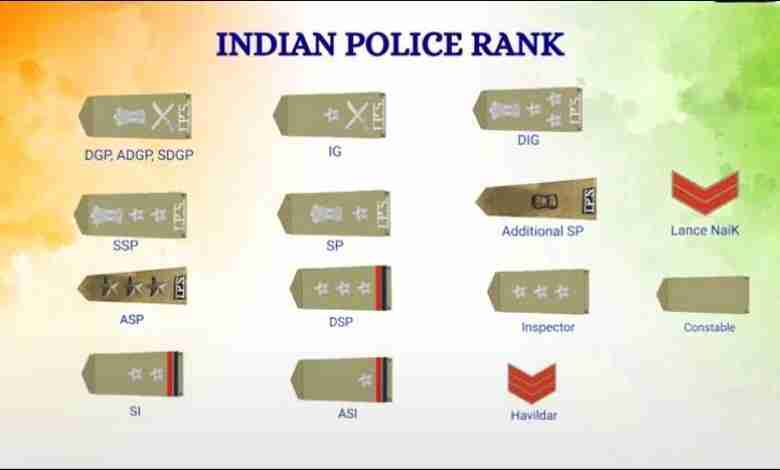
2. Indian Police Services (IPS)
The Indian Police Service (IPS) is distinct from the Indian armed forces. The core function of an IPS officer is to maintain the law and order in their jurisdiction through legal action. They are also responsible for the prevention, detection, and investigation of crimes.
Additionally, things like FIR (First Information Reports), providing security for any major cash transportation, permitting rallies, loudspeakers, or any big gathering, all are taken care of by the IPS.
It is a job that is closer to the regular public and can be very hectic. Here are some allowances and benefits that IPS officers get –
-
Deputy Commissioner of Police (DCP) gets a bungalow with house help, a gardener, and security
-
Dearness allowance
-
Free medical facilities and Provident Fund
-
Travel allowance
-
Annual education allowance for their children
-
Official vehicle with security and driver
-
House Rent Allowance
-
Pension and retirement benefits
-
Free electricity and phone bills
-
Study leaves for 2 years
-
Time-bound promotions
Role: Maintaining law and order, crime control, and leading police forces.
Salary Range: ₹56,000 – ₹2,25,000 per month.
Challenges: Long working hours, public accountability.
For IAS and IPS officers who choose to study higher, the government bears the entire cost of education for two years.
Also Read: Police Ranks in India: Complete Hierarchy Explained ([year])
3. Indian Forest Services (IFS)

The primary objective of an Indian Forest Service Officer is to ensure the security, preservation, and protection of forests within their respective regions. The other objective is to develop forest policy guidelines to ensure environmental sustainability in the particular area where they are posted.
The Indian Forest Service Officer promotes sustainable agriculture, conservation, and management of wildlife habitats with the goal of increasing livelihood opportunities for rural and remote residents.
Key facilities and perks offered to an IFS officer include –
-
Bungalow with house help
-
Travel allowance
-
Dearness allowance
-
Medical benefits
-
Payment of bills
-
Official car with driver
-
Study leaves
-
Pension and retirement benefits
Role: Management of forests, wildlife, and environment policies.
Salary Range: ₹56,000 – ₹2,25,000 per month.
Also Read: List Of All Chief Justices Of India
4. Indian Foreign Services (IFS)
An Indian Foreign Service Officer (IFSO) is an officer who serves in the Ministry of External Affairs and works as India’s ambassador to various countries around the world. They handle relations with other nations and represent India’s foreign policy.
The main tasks of an IFS officer are to help frame policies and directives that govern relations with other countries i.e. diplomacy, trade, and culture relations, and provide assistance in negotiations on behalf of India.
Apart from being one of the highest paying govt jobs in India, it comes with the following facilities and perks –
-
Free medical treatments
-
Official vehicle with driver
-
Tax-free salary
-
Free flight tickets for traveling to India
-
2/3 BHK accommodation with security and house help
-
Free education for kids in the international schools
-
Pension and retirement benefits
Role: Representing India in foreign countries, handling diplomacy, and international relations.
Salary Range: ₹60,000 – ₹2,40,000 per month (with additional foreign allowances depending on country).
Also Read: List of Prime Ministers of India
5. RBI Grade-B Officers
Grade B officers are the backbone of the RBI and are responsible for issuing currency except the Re.1 coin. They supervise the printing of all currency, including Rs.500 and Rs.1,000 rupee notes, as well as coins.
They ensure smooth transactions of currencies within commercial banks registered with the Reserve Bank of India. They are also responsible for ensuring market financial stability by carefully examining the factors that lead to inflation and deflation.
Here are some of the facilities and perks that RBI Grade-B officers get –
-
Medical allowance
-
Dearness allowance
-
Mobile allowance
-
Education allowance
-
HRA
-
Fuel allowance
-
Briefcase allowance
-
Grade allowance
-
Spectacles allowance
-
Leaving fare concession travel
-
Car loans and home loans at easy interest rates
-
Pension and retirement benefits
Role: Policy making, regulation of banking systems, maintaining financial stability.
Salary Range: ₹67,000 – ₹1,20,000 per month.
Why it stands out: Among the most prestigious highest paying government jobs in India in the banking sector.
Also Read: List of Presidents of India
6. Defense Services (Indian Army, Navy, Air Force)

Defense services are one of the highest-paying government jobs in India. The candidates who are interested in joining the defense services must sit through exams such as AFCAT, NDA, CDS, etc.
Candidates who have passed secondary school or graduated are eligible for these posts. So, this is one of the highest paying government jobs in India after 12th. Defense officers have the esteemed honor of working to protect our country’s borders from neighboring attacks and other threats.
It is highly demanding and filled with life-threatening risks. To honor one’s service to the country, the government provides several perks and attractive salaries. Some of the notable benefits are –
-
Flying allowance
-
Dress or uniform allowance
-
Dearness allowance
-
High altitude allowance
-
Free rations
-
Transport allowance
-
Children’s education allowance
-
Siachen allowance
-
Pension and retirement benefits
-
Group insurance
-
Canteen facilities
-
Government accommodation
-
Medical benefits for family and self
Role: Safeguarding national security with positions ranging from Lieutenant to General.
Salary Range: ₹56,000 – ₹2,50,000 per month (plus risk and hardship allowances).
Note: One of the most respected and highest paying government jobs in India after 12th for those who join through NDA.
Also Read: Top 10 Richest People in India
7. Public Sector Undertakings (PSU)

If you are an engineer and do not prefer a corporate lifestyle, you can work with a Public Sector Undertaking. PSUs offer handsome salaries and exceptional job security, but the salaries vary depending on the PSU you work with.
The GATE exam is the most preferred way to get a job in Public Sector Undertakings. These public sector jobs will land you in IOCL, ONGC, SAIL, Coal India, BSNL, MTNL, BPCL, and BHEL.
Even though the salary may vary, these are some perks that come with working at a PSU –
-
Traveling allowance
-
Dearness allowance
-
Children’s education allowance
-
House rent allowance
-
City compensation allowance
-
Health and life insurance
-
Free canteen facilities
-
Free medical care
-
Amazing accommodation
-
Easy access to car and furniture loans
Examples: ONGC, BHEL, NTPC, GAIL.
Salary Range: ₹60,000 – ₹1,80,000 per month.
Pros: Balanced lifestyle, stable career.
Cons: Fewer transfers or international exposure compared to IAS/IFS.
Also Read: Busiest airports in India
8. DRDO and ISRO Scientists
Defence Research and Development Organization or DRDO comes under the Ministry of Defence and has the responsibility of military research and development. Indian Space Research Organization (ISRO) is the premier space agency in India.
Both these organizations are highly prestigious workplaces if you have a passion for research and development. If you are an engineering candidate, you can apply for the position of scientist in DRDO and ISRO.
You can also give exams for ISRO right after your higher secondary exam, which makes this another one of the highest paying government jobs in India after 12th.
Being one of the highest paying government jobs in India, these jobs provide the highest salary and other allowances, which are listed below –
-
Traveling allowance
-
Dearness allowance
-
House rent allowance
-
Leave travel concession
-
Merit-based promotions
-
Allowances for higher education from prestigious universities
-
Free canteen facility
-
Medical facilities
-
Bonus after six months
-
Pension and retirement benefits
-
Group insurance
Role: Research and development in space and defense technologies.
Salary Range: ₹60,000 – ₹1,30,000 per month.
Also Read: Biggest Railway Stations in India
9. Government College Lecturers

Lecturers have the opportunity to shape young minds and define the future of the country. Government college professors take part in enlightening young brains, conducting research, and working towards developing the college structure as a whole.
A government college’s lecturers benefit from the following facilities and advantages –
-
Travel allowance
-
House rent allowance
-
Dearness allowance
-
Leave travel concession
-
Telephone bill reimbursement
-
House or car loan subsidies
-
Sabbatical leaves
-
Medical facilities
Role: Teaching and research in government-funded colleges and universities.
Salary Range: ₹70,000 – ₹2,00,000 per month.
Also Read: Busiest Railway Stations in India
10. Indian Revenue Service (IRS)
The Indian Revenue Service (IRS) is the premier Group-A Central Civil Service of the Government of India, primarily responsible for administering and collecting direct and indirect taxes that fund national governance and development
- Role: Managing taxation policies, revenue collection, and financial laws.
- Salary Range: ₹56,000 – ₹2,10,000 per month.
- Perks:
- Official residence
- Job security
- Significant role in shaping economy
Also Read: Richest States in India
How to Strategically Position Yourself for High-Paying Government Jobs
Most aspirants for government jobs only concentrate on one thing, clearing the exam. Which indeed is the most important part, but this mindset is not enough if you’re looking to get one of the best paying government jobs in India.
Here are the steps you can take to strategically position yourself for highest paying government job:
1. Start with Role Clarity, Not Just Exam Preparation
The biggest mistake that one can make is to prepare without a clear goal in mind. One day they are preparing for UPSC, the next day for Bank Exams, and the day after that for SSC.
Top performers do not do that. They make a decision early in their preparation:
- Administrative Track: UPSC and State PCS
- Financial Track: RBI Grade B and Bank Exams
- Technical Track: PSU and IES
This decision is more important than it seems. This is because each of these tracks requires a totally different approach to preparation.
For example, to prepare for UPSC, one needs to build opinions and write answers. In PSU exams, one needs to be technically correct. Trying to do both together will only result in average performance in both.
Having clarity will not only save you time but also make you prepare better.
2. Understand What the Exam is Actually Testing
This is where most people fail. They prepare for the syllabus but not for the selection logic that is being implemented in the examination.
Each and every examination that is conducted for the highest paying government jobs has one skill to be tested:
- UPSC (IAS/IPS/IFS): It is not just knowledge that is being tested, but also decision-making skills and the ability to think out of the box and have clarity of thought.
- RBI Grade B / Banking Exams: It is not just knowledge that is being tested, but also analytical skills and the ability to work under pressure.
- PSU / GATE / IES Exams: It is not just knowledge that is being tested, but also conceptual knowledge.
Therefore, instead of asking “What should I study?” you should be asking yourself: “What skill is this examination seeking to test?”
3. Build a Preparation Strategy That Matches the Exam
As soon as you understand the examination pattern, your approach to preparation should also change accordingly.
For UPSC (Administrative Roles):
- Answer writing practice is more important than reading
- Make current affairs relevant to static subjects
- Develop your point of view rather than memorizing facts
The key to success in this case is not to read more and more; it is to write more and more.
For RBI / Banking Roles (Financial Track):
- Strengthen your concepts in finance and economics
- Take mock tests regularly under time constraints
- Accuracy is more important than the number of attempts
The key to success in this case is not to attempt more and more; it is to be more and more accurate.
For PSU / GATE / IES (Technical Track):
- Strong concepts are a must; no scope for shortcuts
- Review basic subjects multiple times
- Numerical problems need to be practiced consistently
The key to success in this case is not to read more and more; it is to read fewer and fewer.
4. Create a Competitive Edge Beyond the Syllabus
At some point, all serious aspirants have covered the syllabus. At that point, the real race starts.
This is where you need to go beyond “preparation” and start focusing on “performance factors”:
- Quality of answers: Especially for descriptive exams like UPSC
- Speed vs. accuracy balance: Very important for objective exams
- Interview readiness: Not just knowledge, but a clear thought process too
For instance, in interviews, answers are not judged on correctness alone, but on how clearly and confidently you can present your responses.
5. Think Long-Term, Not Just Exam-Oriented
Preparation for the highest paying government jobs in India is not a short-term task. It is a long and tedious process that takes months and even years.
Those who succeed in this process have a different way of approaching it:
- They focus on the process, not pressure
- They build habits, not just motivation
- They treat preparation as a skill-building journey, not just an exam-oriented task
It is not about working harder to get into top-tier government jobs in India. It is about working with clarity, alignment, and intent. When you know what you want to do, understand how to prepare, and shift your focus from quantity to quality, results start to become more predictable.
Highest Paying Government Jobs in India – Related FAQS
Which Government Job Offers The Utmost Facilities?
The job of an IFS, IPS, and IAS provides the absolute facilities.
What Is The Age Criterion To Attain A Government Job?
You must be 21 years old to sit in a government job exam.
What Steps To Follow To Get A Government Job?
The steps to get a government job are quite straightforward, but cracking them might be difficult. Here is what you need to do to bag a government job –
- Look for the position you want to apply for based on your interests
- Apply for the examination
- Prepare the syllabus accordingly
- Attend the examination
- Check the results
- Most positions allow you to take the exam multiple times, so don’t get discouraged if you don’t crack it on the first attempt.
Which Govt. Is Job Easy To Crack?
- IBPS examinations conducted for clerical recruitment for public sector banks are easiest to crack.
- Which Are The Toughest Government Job Exams In India?
- IIT JEE Entrance Examinations
- UPSC Civil Service Entrance Examinations
- Common Entrance Test (CAT)
- Graduate Aptitude Test in Engineering (GATE)
- National Eligibility cum Entrance Test (NEET)
- National Defense Academy (NDA)
What Government Jobs Can I Apply For After Graduating 12th?
After finishing your 12th, you can opt for a government job if you are passionate about serving the public. There are several government jobs available for 12th graduates.
These are SSC CHSL, NDA, Indian Army, Indian Navy, Indian Coast guard, border security force, and more. These jobs pay well and come with several other benefits.
Are There Any Government Jobs Available For Commerce Students?
There are several government jobs for commerce students. The top 10 highest paying jobs are IBPS PO, RBI Grade B, SBI PO, SBI Clerk, IBPS Clerk, UPSC Civil Services, UPSC CDS, SSC CGL, LIC AAO, and IFS Officer.